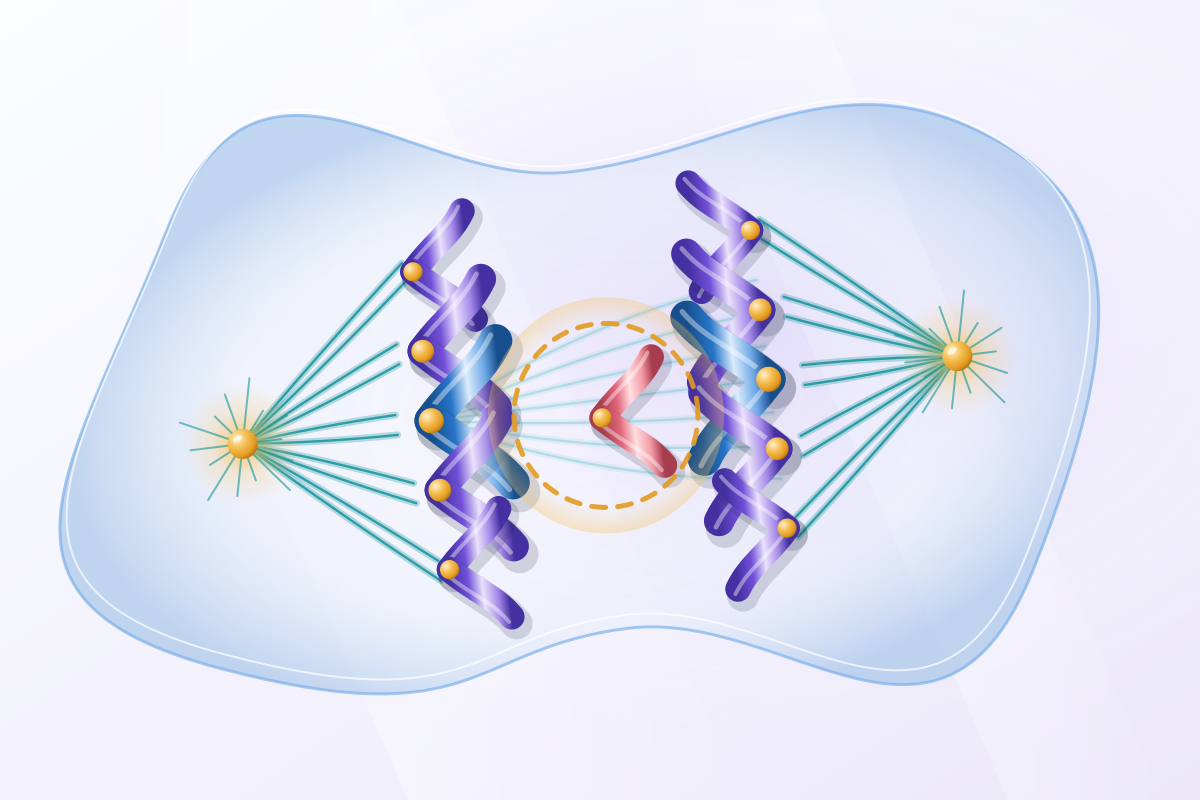
Investigating BUB1B dysfunction in mosaic variegated aneuploidy through reproducible reanalyses, source-linked evidence and explicit functional validation gates.
No exact-genotype pharmacological rescue is established. Wet-lab validation remains future work. This page is research context, not a clinical diagnostic report or a treatment recommendation.
Can public evidence prioritize testable drug-repurposing hypotheses?
Two BUB1B variants raise distinct molecular questions: L737* introduces a premature stop (an RNA and translation question), N1002K is a missense change in the kinase region (a protein stability and function question).
What exists
Reanalyses and audits of published data.
4 quantitative reanalyses, 6 evidence audits and 1 synthetic software test, drawn from primary papers and public perturbation datasets, each labeled with its model and limits.
What remains unresolved
Exact-variant function.
L737* NMD susceptibility is predicted, not measured. N1002K stability and residual function are unresolved. Checkpoint competence and chromosome segregation have not been measured for either variant.
11evidence and software records4quantitative reanalysis charts2variants with distinct functional questionsOpenexact-variant functional validation
Presentación del proyecto
Un recorrido por la evidencia, los candidatos de investigación y el experimento propuesto para BUB1B
Duración Ver en YouTube
Al reproducir se carga el reproductor de YouTube.
Propuesta de investigación. No constituye una recomendación de tratamiento.
Clarification, . The narration (around 01:20 in the automatic transcript) says “12 nearby sequence contexts”. The revision distinguishes 12 measured variant rows representing 8 distinct six-base contexts; they are not independent contexts or biological replicates. The rest of that conclusion stands: no exact L737* measurement was found. The video, its audio and its captions have not been changed, and no full audiovisual review is claimed. Video clarification package
01 / Summary and findings
What the evidence changes.
Two variant questions guide the research. Functional rescue is the deciding endpoint.
L737* / RNA & translation
Preserving RNA leaves the stop codon.
NMD modulation alone cannot establish a useful protein product. Readthrough needs exact-context and functional validation.
Amlexanox remains on hold for nomination until product eligibility is resolved. Montelukast is conditional on useful exact L737* protein function. Gentamicin plus mefloquine remains experimental.
Key areas where additional evidence could inform biology and therapeutic opportunity. Each card opens the matching conceptual viewer or validation plan.
Illustrations explain questions; they do not show experimental results. No exact-genotype rescue is established. Protein shapes are conceptual and are not BUBR1 structures.
Conceptual mechanism explorer
Where could a rescue begin?
Follow the path from a gene to cell division. Choose a research branch to see the mechanism it proposes and the evidence still missing.
Conceptual visualization
Select a branch to highlight its proposed site of action. No biological experiment is running.
Conceptual mechanism · evidence linked
Variant questions
Two unresolved mechanisms
Drag to rotate · pinch or scroll to zoom. Use arrow keys when focused.
Illustration steps · no experiment running · no response calculated
Proposed mechanism · exact-variant response unresolvedIllustrative geometry and colors · not a molecular structure or docking result
Conceptual mechanism · evidence linked
Amlexanox
RNA / readthrough hypothesis
Drag to rotate · pinch or scroll to zoom. Use arrow keys when focused.
Illustration steps · no experiment running · no response calculated
Proposed mechanism · exact-variant response unresolvedIllustrative geometry and colors · not a molecular structure or docking result
Conceptual mechanism · evidence linked
Montelukast
NMD-modulation hypothesis
Drag to rotate · pinch or scroll to zoom. Use arrow keys when focused.
Illustration steps · no experiment running · no response calculated
Proposed mechanism · exact-variant response unresolvedIllustrative geometry and colors · not a molecular structure or docking result
Conceptual mechanism · evidence linked
Gentamicin + mefloquine
Experimental readthrough branch
Drag to rotate · pinch or scroll to zoom. Use arrow keys when focused.
Illustration steps · no experiment running · no response calculated
Proposed mechanism · exact-variant response unresolvedIllustrative geometry and colors · not a molecular structure or docking result
Conceptual mechanism · evidence linked
Arimoclomol
Protein-homeostasis hypothesis
Drag to rotate · pinch or scroll to zoom. Use arrow keys when focused.
Illustration steps · no experiment running · no response calculated
Proposed mechanism · exact-variant response unresolvedIllustrative geometry and colors · not a molecular structure or docking result
Conceptual mechanism · evidence linked
Sirolimus / rapamycin
Cell-state and confounding branch
Drag to rotate · pinch or scroll to zoom. Use arrow keys when focused.
Illustration steps · no experiment running · no response calculated
Proposed mechanism · exact-variant response unresolvedIllustrative geometry and colors · not a molecular structure or docking result
Conceptual mechanism · evidence linked
Immunotherapy / immune senolysis
Downstream exploratory branch
Drag to rotate · pinch or scroll to zoom. Use arrow keys when focused.
Illustration steps · no experiment running · no response calculated
Proposed mechanism · exact-variant response unresolvedIllustrative geometry and colors · not a molecular structure or docking result
Inspect the gene-to-function pathway
Gene → RNA → protein → functionSchematic · not to scale
Hypothesized site of actionUnresolved evidence
No exact-genotype pharmacological rescue is established. Animation illustrates a question; it does not calculate drug efficacy, repair DNA or predict a clinical outcome.
Two unresolved mechanisms
Variant questions
Conditional
Hypothesis
L737* introduces a premature stop; NMD susceptibility is predicted. N1002K raises separate questions about protein stability and residual function.
Next decisive question
Measure exact-variant function before assuming that more RNA or more protein would help.
Inspect recorded evidence
L737* NMD-first: test truncated-protein functionEvidence audit · Completed · Conditional
A related 731X construct motivates testing whether L737* retains useful function when NMD is bypassed. The exact L737* experiment has not been performed.
No exact-N1002K functional experiment was located. I909T/L1012P checkpoint rescue at matched abundance makes an abundance-limited mechanism plausible, but equally expressed B56-binding mutants still failed chromosome-congression rescue and mouse L1012P showed allelic effects beyond total protein level. Stabilization remains conditional; no drug is promoted.
Evidence from the current deployed snapshot. Wet-lab validation remains future work.
RNA / readthrough hypothesis
Amlexanox
Conditional
Hypothesis
Explore context-dependent NMD modulation and stop-codon readthrough. The highlighted steps are proposed sites of action, not measured effects in BUB1B.
Next decisive question
Can exact-L737*-derived full-length BUBR1 be demonstrated alongside independent checkpoint and segregation improvement?
Functional CFTR evidence supports investigating amlexanox, but negative NEFL rescue with neurite toxicity and context-dependent NMD responses prevent promotion to an established lead. GDAP1 immunofluorescence does not by itself resolve full-length protein. No exact-L737* rescue is established.
Montelukast has a published permutation q of 0.021150, but the response is reporter-dependent and confounded by non-NMD isoform changes. No hit establishes functional BUBR1 rescue.
L737* NMD-first: test truncated-protein functionEvidence audit · Completed · Conditional
A related 731X construct motivates testing whether L737* retains useful function when NMD is bypassed. The exact L737* experiment has not been performed.
Evidence from the current deployed snapshot. Wet-lab validation remains future work.
Experimental readthrough branch
Gentamicin + mefloquine
Conditional
Hypothesis
Explore bypass of a premature stop during translation. Combination evidence from other genes does not establish this combination's efficacy in BUB1B.
Next decisive question
Test the exact L737* context and protein product. Readthrough need not restore native leucine or functional BUBR1.
Inspect recorded evidence
Readthrough combinations: endogenous-protein transfer gapEvidence audit · Completed · Conditional
G418/ELX-02 with or without mefloquine were studied beyond reporters, including endogenous PKD1 protein and withdrawal measurements. This does not establish gentamicin-combination efficacy or BUB1B rescue.
L737* readthrough: exact versus nearby contextsReanalysis · Completed · Deprioritized
No exact L737* measurement or exact six-flanking-base match in the 5,837-PTC table. Twelve nearest contexts have a median paired gentamicin increment of 0.0165 percentage points.
No direct BUBR1 or N1002K rescue evidence was located in the audit. Heat-shock responses are context-dependent; arimoclomol is not promoted to lead candidate.
No exact-N1002K functional experiment was located. I909T/L1012P checkpoint rescue at matched abundance makes an abundance-limited mechanism plausible, but equally expressed B56-binding mutants still failed chromosome-congression rescue and mouse L1012P showed allelic effects beyond total protein level. Stabilization remains conditional; no drug is promoted.
Evidence from the current deployed snapshot. Wet-lab validation remains future work.
Cell-state and confounding branch
Sirolimus / rapamycin
Conditional
Hypothesis
Explore how altered cell state could affect the interpretation of a rescue assay. The public fibroblast reanalysis does not support an RNA-abundance-increase rationale in that model.
Next decisive question
Separate cytostasis from improved segregation per completed division, including a future transient-exposure/washout comparison.
Inspect recorded evidence
Rapamycin in human fibroblasts: BUB1B locus RNA signalReanalysis · Completed · Conditional
The primary BUB1B-spanning feature has a Rap/Pro mean ratio of 0.585706 (41.43% lower); reduced-serum/Pro is 0.186191. Three nearly full-span features give the same direction. This does not support an RNA-abundance-increase rationale for sirolimus in this model.
Cytostasis confounding: denominator unit testSoftware test · Completed · Control only
The synthetic fixture flags fewer raw error-positive divisions without a lower error rate per completed division. It does not measure sirolimus activity.
Evidence from the current deployed snapshot. Wet-lab validation remains future work.
Downstream exploratory branch
Immunotherapy / immune senolysis
Deprioritized
Hypothesis
Explore a future hypothesis of selectively removing harmful senescent cells. This would not repair BUB1B; tumor control is a different outcome from disease rescue.
Next decisive question
Establish a selectively targetable harmful cell population in a relevant BUB1B model while preserving normal tissue function.
Genetic senescent-cell ablation delayed selected phenotypes in BubR1-deficient mice; uPAR CAR T benefits came from other mouse models. HER2 CAR T and nivolumab/ipilimumab show limited antitumor signals in sarcoma, while nivolumab monotherapy lacked solid-tumor responses in ADVL1412. Tumor control does not establish BUB1B rescue. No exact-genotype immunotherapy rescue was located.
Evidence from the current deployed snapshot. Wet-lab validation remains future work.
Illustrated methods
Inside each analysis.
Explore what each record examined, what it found and what still needs validation. The illustrations explain the method; the evidence below provides the result.
Conceptual method illustrations. No experiment is running and no new result is calculated.
Conceptual method · Reanalysis
Reporter response is a question about context.
Drag to rotate · pinch or scroll to zoom. Use arrow keys when focused.
Illustration steps · no experiment running · no response calculated
Compare published reporter and isoform responses. A ratio cannot isolate NMD or demonstrate BUBR1 function.Illustrative geometry and colors · not a molecular simulation
MVA-NMD-003
704-drug NMD screen: reporter specificity
ReanalysisCompletedConditional
The status refers to the recorded analysis, not biological rescue.
Recorded finding
Montelukast has a published permutation q of 0.021150, but the response is reporter-dependent and confounded by non-NMD isoform changes. No hit establishes functional BUBR1 rescue.
Model / scope
Published mouse Neuro-2a AS-NMD isoform summaries; three reporter genes, not BUB1B.
Next question · proposed
Establish L737* residual function first; any NMD candidate then needs allele-specific RNA, protein synthesis, and separate checkpoint/segregation endpoints.
Drag to rotate · pinch or scroll to zoom. Use arrow keys when focused.
Illustration steps · no experiment running · no response calculated
Inspect neighboring published readthrough contexts while keeping the exact L737* response unresolved.Illustrative geometry and colors · not a molecular simulation
MVA-RT-002
L737* readthrough: exact versus nearby contexts
ReanalysisCompletedDeprioritized
The status refers to the recorded analysis, not biological rescue.
Recorded finding
No exact L737* measurement or exact six-flanking-base match in the 5,837-PTC table. Twelve nearest contexts have a median paired gentamicin increment of 0.0165 percentage points.
Model / scope
Published 144-nt PTC reporters in human cells; nearest-context subset, not endogenous BUB1B.
Next question · proposed
Use the exact L737* context with matched controls and independently test full-length protein, checkpoint response and segregation fidelity.
Drag to rotate · pinch or scroll to zoom. Use arrow keys when focused.
Illustration steps · no experiment running · no response calculated
A published WT versus D137R arrest-duration control. This is neither a drug experiment nor the N1002K variant.Illustrative geometry and colors · not a molecular simulation
MVA-CTRL-006
BUBR1 functional controls: arrest duration
ReanalysisCompletedControl only
The status refers to the recorded analysis, not biological rescue.
Recorded finding
Figure 4B source-data medians are 650 minutes for WT and 60 minutes for D137R. A control for checkpoint competence, not a drug-rescue result.
Model / scope
Published HeLa BUBR1 depletion/replacement with WT or engineered TPR variants under nocodazole challenge.
Next question · proposed
Require independent checkpoint and chromosome-segregation readouts in future equal-expression assays.
Drag to rotate · pinch or scroll to zoom. Use arrow keys when focused.
Illustration steps · no experiment running · no response calculated
An evidence audit motivates future matched-abundance functional measurements. The displayed protein is not a calculated N1002K structure.Illustrative geometry and colors · not a molecular simulation
MVA-N1002K-GATE-002
N1002K stabilization: equal-expression gate
Evidence auditCompletedConditional
The status refers to the recorded analysis, not biological rescue.
Recorded finding
No exact-N1002K functional experiment was located. I909T/L1012P checkpoint rescue at matched abundance makes an abundance-limited mechanism plausible, but equally expressed B56-binding mutants still failed chromosome-congression rescue and mouse L1012P showed allelic effects beyond total protein level. Stabilization remains conditional; no drug is promoted.
Model / scope
Published human-cell BUBR1 depletion/replacement studies, MVA fibroblast rescue and a mouse L1012P comparator model; none tests N1002K.
Next question · proposed
At measured matched abundance, compare WT, N1002K and L1012P in one depletion-replacement system; report nocodazole checkpoint arrest separately from chromosome alignment and missegregation per completed division. Wet-lab work is deferred.
Drag to rotate · pinch or scroll to zoom. Use arrow keys when focused.
Illustration steps · no experiment running · no response calculated
Preserving a stop-containing RNA does not remove its stop codon. Exact L737* function remains a proposed validation question.Illustrative geometry and colors · not a molecular simulation
MVA-L737-NMD-FIRST-001
L737* NMD-first: test truncated-protein function
Evidence auditCompletedConditional
The status refers to the recorded analysis, not biological rescue.
Recorded finding
A related 731X construct motivates testing whether L737* retains useful function when NMD is bypassed. The exact L737* experiment has not been performed.
Model / scope
Published 731X/753X BUBR1 constructs and a proposed exact-L737* validation design.
Next question · proposed
Test WT, clean L737*, 731X and 753X at matched abundance; advance NMD modulation only if the exact truncation retains useful function.
Drag to rotate · pinch or scroll to zoom. Use arrow keys when focused.
Illustration steps · no experiment running · no response calculated
Review indirect protein-homeostasis evidence and exposure limitations. No direct BUBR1 binding or stabilization is illustrated as established.Illustrative geometry and colors · not a molecular simulation
MVA-ARI-007
Arimoclomol: target engagement and exposure gap
Evidence auditCompletedDeprioritized
The status refers to the recorded analysis, not biological rescue.
Recorded finding
No direct BUBR1 or N1002K rescue evidence was located in the audit. Heat-shock responses are context-dependent; arimoclomol is not promoted to lead candidate.
Model / scope
Human-cell heat-shock studies and a nominal molar conversion of FDA-label serum concentrations.
Next question · proposed
Require target engagement at relevant exposure plus exact-variant functional rescue before reconsidering prioritization.
Check the denominator before interpreting fewer errors.
Drag to rotate · pinch or scroll to zoom. Use arrow keys when focused.
Illustration steps · no experiment running · no response calculated
A synthetic software fixture distinguishes raw error counts from errors per completed division. No cells or drug effects were measured by this test.Illustrative geometry and colors · not a molecular simulation
MVA-FUNC-005
Cytostasis confounding: denominator unit test
Software testCompletedControl only
The status refers to the recorded analysis, not biological rescue.
Recorded finding
The synthetic fixture flags fewer raw error-positive divisions without a lower error rate per completed division. It does not measure sirolimus activity.
Model / scope
Invented test counts used only to test code; not an experiment or a biological simulation.
Next question · proposed
Reuse the denominator checks with prospectively designed real measurements when wet-lab work becomes available.
Drag to rotate · pinch or scroll to zoom. Use arrow keys when focused.
Illustration steps · no experiment running · no response calculated
Reanalyze deposited RNA signals from proliferative, rapamycin-treated and reduced-serum normal human fibroblasts. The dishes are illustrations, not culture images from this project.Illustrative geometry and colors · not a molecular simulation
MVA-RAP-GSE65145-001
Rapamycin in human fibroblasts: BUB1B locus RNA signal
ReanalysisCompletedConditional
The status refers to the recorded analysis, not biological rescue.
Recorded finding
The primary BUB1B-spanning feature has a Rap/Pro mean ratio of 0.585706 (41.43% lower); reduced-serum/Pro is 0.186191. Three nearly full-span features give the same direction. This does not support an RNA-abundance-increase rationale for sirolimus in this model.
Model / scope
Normal 2DD fibroblasts: proliferative vehicle, 0.5% serum, or 500 nM rapamycin for five days; two biological replicates per condition.
Next question · proposed
Keep sirolimus conditional. Proposed: compare full-length BUBR1 protein and segregation errors per completed division after transient exposure and washout at matched cell-cycle distribution. Wet-lab work is deferred.
Evidence in another gene does not transfer automatically.
Drag to rotate · pinch or scroll to zoom. Use arrow keys when focused.
Illustration steps · no experiment running · no response calculated
Audit endogenous-protein and withdrawal evidence from other genes. Exact BUB1B function remains unresolved.Illustrative geometry and colors · not a molecular simulation
MVA-RT-TRANSFER-009
Readthrough combinations: endogenous-protein transfer gap
Evidence auditCompletedConditional
The status refers to the recorded analysis, not biological rescue.
Recorded finding
G418/ELX-02 with or without mefloquine were studied beyond reporters, including endogenous PKD1 protein and withdrawal measurements. This does not establish gentamicin-combination efficacy or BUB1B rescue.
Model / scope
Published HEK293 PKD1 reporters and WT9-12 cells bearing endogenous PKD1 Q2556X; not BUB1B.
Next question · proposed
Keep gentamicin plus mefloquine experimental only; add ELX-02 to proposed mechanistic comparators, not the repurposing lead list. Require exact-L737* RNA, full-length protein and checkpoint/segregation outcomes after withdrawal. Wet-lab deferred.
Supporting evidence and counterevidence belong together.
Drag to rotate · pinch or scroll to zoom. Use arrow keys when focused.
Illustration steps · no experiment running · no response calculated
Review positive and negative findings in different genes and models. The scene does not show an amlexanox docking pose or a measured BUB1B response.Illustrative geometry and colors · not a molecular simulation
MVA-AMLEXANOX-010
Amlexanox: context-dependent readthrough evidence
Evidence auditCompletedConditional
The status refers to the recorded analysis, not biological rescue.
Recorded finding
Functional CFTR evidence supports investigating amlexanox, but negative NEFL rescue with neurite toxicity and context-dependent NMD responses prevent promotion to an established lead. GDAP1 immunofluorescence does not by itself resolve full-length protein. No exact-L737* rescue is established.
Model / scope
Published CFTR cells, GDAP1 neuronal progenitors, NEFL motor neurons and mouse NMD reporters; no exact BUB1B model.
Next question · proposed
Can exact-L737*-derived full-length BUBR1 be demonstrated at an exposure that also improves checkpoint and segregation independently of cytostasis? Require allele attribution, viability/proliferation controls and separate functional endpoints. Wet-lab validation remains proposed.
Targeting a cell is different from restoring BUB1B.
Drag to rotate · pinch or scroll to zoom. Use arrow keys when focused.
Illustration steps · no experiment running · no response calculated
Keep genetic ablation, immune senolysis and antitumor findings distinct. No immune killing or corrected chromosome segregation is shown as an MVA result.Illustrative geometry and colors · not a molecular simulation
MVA-IMMUNE-011
Immunotherapy: disease rescue versus tumor control
Evidence auditCompletedDeprioritized
The status refers to the recorded analysis, not biological rescue.
Recorded finding
Genetic senescent-cell ablation delayed selected phenotypes in BubR1-deficient mice; uPAR CAR T benefits came from other mouse models. HER2 CAR T and nivolumab/ipilimumab show limited antitumor signals in sarcoma, while nivolumab monotherapy lacked solid-tumor responses in ADVL1412. Tumor control does not establish BUB1B rescue. No exact-genotype immunotherapy rescue was located.
Model / scope
BubR1 H/H INK-ATTAC mice; separate aging/metabolic CAR T mouse models; early human sarcoma studies. No exact BUB1B variant model.
Next question · proposed
Retain immune senolysis as future exploratory research, not the immediate BUB1B rescue lead. Does a relevant BUB1B model contain harmful senescent cells with a selectively targetable surface antigen while preserving normal/progenitor cells and tissue function? Wet-lab validation remains proposed.
Separate assays, separate scales. No clinical probabilities or efficacy scores. Every chart names its model, unit, exact values and limitations.
MVA-NMD-003
One drug, three different reporter responses
NMD / non-NMD normalized RNA ratio · zero-based scale
Model / scopePublished mouse Neuro-2a AS-NMD isoform summaries; three reporter genes, not BUB1B.
Ptbp2HnrnplTra2b
01530
Montelukast sodium
1.3154
3.4065
1.7655
Artesunate
1.7181
1.0079
4.2875
Cladribine
2.1261
2.082
1.6377
Albendazole
1.5635
1.7017
3.2992
Topotecan hydrochloride
3.9533
2.3994
0.65428
Homoharringtonine
5.0039
24.976
11.673
Mefloquine hydrochloride
1.1816
1.3075
1.5102
Nicotinic acid
1.1859
1.4153
0.91717
Dashed line: reference ratio 1.
Selected compounds from a 704-drug mouse-cell screen, not a therapeutic ranking. Ratios can rise when the denominator falls. No BUB1B was measured; no valid replicate-based ratio error bars are available. Source & limits ↗View exact chart values
One drug, three different reporter responses — NMD / non-NMD normalized RNA ratio
Condition
Ptbp2
Hnrnpl
Tra2b
Context
Montelukast sodium
1.3153820850896314
3.406494677098417
1.7654686351224798
Published permutation q = 0.02115; not a BUBR1 endpoint.
Artesunate
1.718112969537028
1.0078988102818638
4.2875477079256585
Published permutation q = 0.010071; not a BUBR1 endpoint.
Cladribine
2.126124275101715
2.0820411294900216
1.6377191943091594
Published permutation q = 0.010071; not a BUBR1 endpoint.
Albendazole
1.5634627380948676
1.701726223666598
3.2992143735876955
Published permutation q = 0.015667; not a BUBR1 endpoint.
Topotecan hydrochloride
3.9533398228039465
2.3994174963086077
0.6542839291174242
Published permutation q = 0.0 (finite-sampling zero, not zero uncertainty); not a BUBR1 endpoint.
Homoharringtonine
5.0039366160196295
24.97590928901173
11.672927661494484
Published permutation q = 0.0 (finite-sampling zero, not zero uncertainty); not a BUBR1 endpoint.
Mefloquine hydrochloride
1.181600971576268
1.3075083215610865
1.5102164979716604
Published permutation q = 0.061224; not a BUBR1 endpoint.
Nicotinic acid
1.1859031685137231
1.4152893426077033
0.9171679519898492
Published permutation q = 0.08225; not a BUBR1 endpoint.
MVA-RT-002
Nearby contexts are not the exact variant
Median reporter readthrough (%) · zero-based scale
Model / scopePublished 144-nt PTC reporters in human cells; nearest-context subset, not endogenous BUB1B.
Median
00.10.2
Untreated
0.1745
Gentamicin
0.1985
Median paired increment: 0.0165 percentage points; it is not the difference of the two medians. The six-base analogy ignores the rest of the reporter sequence. No rescue probability is computed. Source & limits ↗View exact chart values
Nearby contexts are not the exact variant — Median reporter readthrough (%)
Same 12 contexts, not BUB1B efficacy or a patient prediction.
MVA-CTRL-006
Checkpoint competence needs its own control
Median NEBD-to-exit time (minutes) · zero-based scale
Model / scopePublished HeLa BUBR1 depletion/replacement with WT or engineered TPR variants under nocodazole challenge.
Median
0350700
Wild type
650
D137R
60
Published Figure 4B under nocodazole challenge. WT and D137R are not drug-treatment arms. These cell counts do not establish between-replicate precision; no confidence interval is inferred. Source & limits ↗View exact chart values
Checkpoint competence needs its own control — Median NEBD-to-exit time (minutes)
Condition
Median
Context
Wild type
650
27 cells; representative replicate, not independent biological replicates.
D137R
60
39 cells; representative replicate, not independent biological replicates.
MVA-RAP-GSE65145-001
BUB1B-spanning RNA feature in normal human fibroblasts
RPKM as deposited; genomic-span RNA feature · zero-based scale
Model / scopeNormal 2DD fibroblasts: proliferative vehicle, 0.5% serum, or 500 nM rapamycin for five days; two biological replicates per condition.
Biological replicate 1Biological replicate 2
03.57
Proliferative vehicle
6.2272
5.5708
Reduced serum
1.2675
0.9292
Rapamycin 500 nM
3.7115
3.1987
GSE65145; two biological replicates per condition from one normal cell line. Continuous rapamycin for five days; no washout. The selected unstranded feature spans chr15:40453238–40513321 (hg19). No protein, checkpoint-rescue or statistical-significance claim. Overlapping features are not extra replicates. Source & limits ↗View exact chart values
BUB1B-spanning RNA feature in normal human fibroblasts — RPKM as deposited; genomic-span RNA feature
Condition
Biological replicate 1
Biological replicate 2
Context
Proliferative vehicle
6.227185
5.570779
10% FBS; DMSO vehicle.
Reduced serum
1.2674783
0.9291951
0.5% FBS for five days; not matched for cell-cycle distribution.
Rapamycin 500 nM
3.7114706
3.198672
500 nM for five days; 10% FBS. Mean is 0.585706 times proliferative control.
04 / Evidence records
Evidence you can inspect.
Recorded analyses, their limits, and the next experiment that could change the decision.
Versioned snapshot · not a live runnerData as of mva-results-2026-10-17-immunotherapy-audit-v1
Research, not a treatment recommendation. Public literature, computational reanalyses and explicitly labeled synthetic software checks only. Wet-lab validation is deferred. No private genomic data are included. The GSE65145 summary and N1002K equal-expression audit were checked by the research assistant for source support, privacy and scientific limits; neither has received independent human scientific review. The readthrough-transfer audit is assistant-reviewed, not independently human-reviewed. The immunotherapy audit is assistant-reviewed, not independently human-reviewed, and distinguishes tumor control from BUB1B disease rescue. “Completed” describes the recorded computational or review work, not biological validation. No exact-genotype pharmacologic rescue is established in this snapshot.
4Reanalysisrecords in this snapshot
6Evidence auditrecords in this snapshot
1Software testrecords in this snapshot
0Proposed experimentrecords in this snapshot
The research register.
Filter the recorded work, then open a record for its sources, method and limitations.
11 records. Expand a record to inspect evidence and provenance.
Research register — execution state and scientific decision are separate fields
Montelukast has a published permutation q of 0.021150, but the response is reporter-dependent and confounded by non-NMD isoform changes. No hit establishes functional BUBR1 rescue.
No exact L737* measurement or exact six-flanking-base match in the 5,837-PTC table. Twelve nearest contexts have a median paired gentamicin increment of 0.0165 percentage points.
Evidence auditCompleted · DIRECT-BUBR1 COMPARATORS / RELATED-VARIANT IN VIVO / TARGETED AUDIT
Read the recorded finding
No exact-N1002K functional experiment was located. I909T/L1012P checkpoint rescue at matched abundance makes an abundance-limited mechanism plausible, but equally expressed B56-binding mutants still failed chromosome-congression rescue and mouse L1012P showed allelic effects beyond total protein level. Stabilization remains conditional; no drug is promoted.
A related 731X construct motivates testing whether L737* retains useful function when NMD is bypassed. The exact L737* experiment has not been performed.
No direct BUBR1 or N1002K rescue evidence was located in the audit. Heat-shock responses are context-dependent; arimoclomol is not promoted to lead candidate.
The synthetic fixture flags fewer raw error-positive divisions without a lower error rate per completed division. It does not measure sirolimus activity.
ReanalysisCompleted · Public human perturbation data; descriptive locus-level RNA reanalysis, not functional rescue.
Read the recorded finding
The primary BUB1B-spanning feature has a Rap/Pro mean ratio of 0.585706 (41.43% lower); reduced-serum/Pro is 0.186191. Three nearly full-span features give the same direction. This does not support an RNA-abundance-increase rationale for sirolimus in this model.
G418/ELX-02 with or without mefloquine were studied beyond reporters, including endogenous PKD1 protein and withdrawal measurements. This does not establish gentamicin-combination efficacy or BUB1B rescue.
Functional CFTR evidence supports investigating amlexanox, but negative NEFL rescue with neurite toxicity and context-dependent NMD responses prevent promotion to an established lead. GDAP1 immunofluorescence does not by itself resolve full-length protein. No exact-L737* rescue is established.
Evidence auditCompleted · DIRECT-BUBR1 MOUSE ABLATION / OTHER-MODEL CAR T / CLINICAL ONCOLOGY / OUR INFERENCE
Read the recorded finding
Genetic senescent-cell ablation delayed selected phenotypes in BubR1-deficient mice; uPAR CAR T benefits came from other mouse models. HER2 CAR T and nivolumab/ipilimumab show limited antitumor signals in sarcoma, while nivolumab monotherapy lacked solid-tumor responses in ADVL1412. Tumor control does not establish BUB1B rescue. No exact-genotype immunotherapy rescue was located.
Deprioritized
No matching records. Change or reset the filters.
Evidence & next validation gates.
Sources describe published experiments. Proposed validation below has not been performed by this project.
Published mouse Neuro-2a AS-NMD isoform summaries; three reporter genes, not BUB1B.
Finding
Montelukast has a published permutation q of 0.021150, but the response is reporter-dependent and confounded by non-NMD isoform changes. No hit establishes functional BUBR1 rescue.
Decision
Conditional
Next validation — proposed
Establish L737* residual function first; any NMD candidate then needs allele-specific RNA, protein synthesis, and separate checkpoint/segregation endpoints.
Limitations and contradictory evidence
Normalized RNA ratios cannot isolate decay from splicing or isoform regulation.
Replicate Ct values are unavailable. Published ratio SEM formulas do not provide valid replicate-based uncertainty; no error bars are shown.
Translation inhibition is counterevidence for homoharringtonine. Statistical significance is not therapeutic suitability.
Extracted named compounds and ratios from the existing independently reconstructed Table S2/S4 analysis; published q values are not clinical probabilities.
Verification scope
Imported an existing analysis artifact and computed its SHA-256. This snapshot build does not rerun the original analysis or validate biological efficacy.
Artifact names and hashes identify the imported analysis package; they are not links to patient data or a claim that unpublished artifacts exist in the public research repository.
MVA-RT-002L737* readthrough: exact versus nearby contextsReanalysis
Published 144-nt PTC reporters in human cells; nearest-context subset, not endogenous BUB1B.
Finding
No exact L737* measurement or exact six-flanking-base match in the 5,837-PTC table. Twelve nearest contexts have a median paired gentamicin increment of 0.0165 percentage points.
Decision
Deprioritized
Next validation — proposed
Use the exact L737* context with matched controls and independently test full-length protein, checkpoint response and segregation fidelity.
Limitations and contradictory evidence
Neighboring-context values are not a prediction for L737* or the child.
The main predictive analysis excluded gentamicin for weak signal.
Readthrough does not guarantee native leucine, endogenous transcript survival, or functional BUBR1. Gentamicin plus mefloquine remains an experimental branch only.
Extracted medians from the existing nearest-context reanalysis. The paired median increment is not the difference of group medians.
Verification scope
Imported an existing analysis artifact and computed its SHA-256. This snapshot build does not rerun the original analysis or validate biological efficacy.
Artifact names and hashes identify the imported analysis package; they are not links to patient data or a claim that unpublished artifacts exist in the public research repository.
Selected the Figure 4B rows from a completed deterministic source-workbook reanalysis; no kinetic rate or new confidence interval inferred.
Verification scope
Imported an existing analysis artifact and computed its SHA-256. This snapshot build does not rerun the original analysis or validate biological efficacy.
Artifact names and hashes identify the imported analysis package; they are not links to patient data or a claim that unpublished artifacts exist in the public research repository.
DIRECT-BUBR1 COMPARATORS / RELATED-VARIANT IN VIVO / TARGETED AUDIT
Model / scope
Published human-cell BUBR1 depletion/replacement studies, MVA fibroblast rescue and a mouse L1012P comparator model; none tests N1002K.
Finding
No exact-N1002K functional experiment was located. I909T/L1012P checkpoint rescue at matched abundance makes an abundance-limited mechanism plausible, but equally expressed B56-binding mutants still failed chromosome-congression rescue and mouse L1012P showed allelic effects beyond total protein level. Stabilization remains conditional; no drug is promoted.
Decision
Conditional
Next validation — proposed
At measured matched abundance, compare WT, N1002K and L1012P in one depletion-replacement system; report nocodazole checkpoint arrest separately from chromosome alignment and missegregation per completed division. Wet-lab work is deferred.
Limitations and contradictory evidence
This targeted audit is not a systematic review; failure to locate an exact-N1002K study does not prove that none exists.
I909T and L1012P are comparator variants, not substitutes for N1002K.
B56-binding mutants lie in a different region and demonstrate only that equal abundance is not universally sufficient.
Mouse L1002P models human L1012P, not human N1002K.
Checkpoint-only rescue must not be relabeled as chromosome-alignment or segregation rescue.
The published 6% versus 13% titration is cell-line-specific, not a universal functional or clinical threshold.
HeLa BUBR1 depletion/reconstitution and BUB1B-mutated MVA fibroblast rescue · Figures 2 and 4; equally expressed B56-binding mutants are functional counterexamples
Targeted exact-variant search plus primary-study comparison of abundance-matched BUBR1 rescue and counterexamples; no biological simulation was executed.
Verification scope
Primary-source claims were checked against PMID 20516114 Figures 2D/3/4D, PMID 23789096 Figures 2/4 and PMID 31738183 Figures 1-3. Artifact bytes were hashed directly. No independent human scientific review or biological efficacy validation is claimed.
Artifact names and hashes identify the imported analysis package; they are not links to patient data or a claim that unpublished artifacts exist in the public research repository.
MVA-L737-NMD-FIRST-001L737* NMD-first: test truncated-protein functionEvidence audit
Published 731X/753X BUBR1 constructs and a proposed exact-L737* validation design.
Finding
A related 731X construct motivates testing whether L737* retains useful function when NMD is bypassed. The exact L737* experiment has not been performed.
Decision
Conditional
Next validation — proposed
Test WT, clean L737*, 731X and 753X at matched abundance; advance NMD modulation only if the exact truncation retains useful function.
Limitations and contradictory evidence
731X is a frameshift product with about 715 native residues, not a clean L737* surrogate.
NMD sensitivity is predicted, not measured for this child.
More nonsense transcript can increase nonfunctional protein; NMD inhibition does not itself remove a stop codon.
Imported an evidence-supported proposed design. Completed refers to the audit, not execution of the wet-lab validation.
Verification scope
Imported an existing analysis artifact and computed its SHA-256. This snapshot build does not rerun the original analysis or validate biological efficacy.
Artifact names and hashes identify the imported analysis package; they are not links to patient data or a claim that unpublished artifacts exist in the public research repository.
MVA-ARI-007Arimoclomol: target engagement and exposure gapEvidence audit
Human-cell heat-shock studies and a nominal molar conversion of FDA-label serum concentrations.
Finding
No direct BUBR1 or N1002K rescue evidence was located in the audit. Heat-shock responses are context-dependent; arimoclomol is not promoted to lead candidate.
Decision
Deprioritized
Next validation — proposed
Require target engagement at relevant exposure plus exact-variant functional rescue before reconsidering prioritization.
Limitations and contradictory evidence
Published human-cell systems report both conditional induction and negative responses.
Total serum exposure and nominal cell-culture concentration are not pharmacokinetically interchangeable.
Approval for a different disease does not establish MVA efficacy.
Imported the existing nominal concentration conversion; no tissue distribution, free-drug exposure or rescue model was calculated.
Verification scope
Imported an existing analysis artifact and computed its SHA-256. This snapshot build does not rerun the original analysis or validate biological efficacy.
Artifact names and hashes identify the imported analysis package; they are not links to patient data or a claim that unpublished artifacts exist in the public research repository.
MVA-FUNC-005Cytostasis confounding: denominator unit testSoftware test
Invented test counts used only to test code; not an experiment or a biological simulation.
Finding
The synthetic fixture flags fewer raw error-positive divisions without a lower error rate per completed division. It does not measure sirolimus activity.
Decision
Control only
Next validation — proposed
Reuse the denominator checks with prospectively designed real measurements when wet-lab work becomes available.
Limitations and contradictory evidence
All fixture counts are synthetic.
No drug response, BUBR1 rescue, or patient outcome can be inferred from a passing software test.
Sources
Project-generated synthetic software fixture. Not a published biological result.
Imported the labeled fixture output, checked the synthetic flag, and excluded synthetic quantities from the scientific charts.
Verification scope
Imported an existing analysis artifact and computed its SHA-256. This snapshot build does not rerun the original analysis or validate biological efficacy.
Artifact names and hashes identify the imported analysis package; they are not links to patient data or a claim that unpublished artifacts exist in the public research repository.
MVA-RAP-GSE65145-001Rapamycin in human fibroblasts: BUB1B locus RNA signalReanalysis
Public human perturbation data; descriptive locus-level RNA reanalysis, not functional rescue.
Model / scope
Normal 2DD fibroblasts: proliferative vehicle, 0.5% serum, or 500 nM rapamycin for five days; two biological replicates per condition.
Finding
The primary BUB1B-spanning feature has a Rap/Pro mean ratio of 0.585706 (41.43% lower); reduced-serum/Pro is 0.186191. Three nearly full-span features give the same direction. This does not support an RNA-abundance-increase rationale for sirolimus in this model.
Decision
Conditional
Next validation — proposed
Keep sirolimus conditional. Proposed: compare full-length BUBR1 protein and segregation errors per completed division after transient exposure and washout at matched cell-cycle distribution. Wet-lab work is deferred.
Limitations and contradictory evidence
Unstranded genomic-span features, not direct BUBR1 protein measurements or validated mature transcript isoform estimates.
Three overlapping features are sensitivity views of the same locus, not independent biological replicates.
Two biological replicates per condition from one normal cell line; no MVA genotype and no donor-level replication.
Serum reduction is a useful control but is not matched to rapamycin for cell-cycle distribution; no causal proliferation adjustment is claimed.
Continuous 500 nM/five-day treatment; no washout, transient exposure, aneuploidy, mitotic checkpoint or rescue endpoint.
Published normalized RPKM values are used as deposited without re-alignment, count-based differential expression, an added pseudocount, p-values or rescue probabilities.
149122 rows were observed in each deposited track; the paper states 149135 probes. The 13-row difference is not resolved here.
This does not establish that BUBR1 protein falls, rule out post-transcriptional effects, or predict clinical harm or benefit.
2DD normal human foreskin fibroblasts; two biological replicates per condition · GSE65145 processed tracks; Figures 1 and 3; Figure S2; Cell culture and RNA-seq methods
Parse six deposited hg19 RPKM tracks; require >=99% reciprocal overlap with RefSeq NM_001211.6; select minimum boundary-distance feature and calculate ratios of arithmetic means. Check all three qualifying features.
Verification scope
All six coordinate arrays match; each has 149122 rows. Eighteen rows overlap the anchor and three qualify. GEO sample titles and artifact hashes verified. Complete reproducible package saved separately; no human scientific review or new biological experiment is claimed.
Artifact names and hashes identify the imported analysis package; they are not links to patient data or a claim that unpublished artifacts exist in the public research repository.
MVA-RT-TRANSFER-009Readthrough combinations: endogenous-protein transfer gapEvidence audit
Published HEK293 PKD1 reporters and WT9-12 cells bearing endogenous PKD1 Q2556X; not BUB1B.
Finding
G418/ELX-02 with or without mefloquine were studied beyond reporters, including endogenous PKD1 protein and withdrawal measurements. This does not establish gentamicin-combination efficacy or BUB1B rescue.
Decision
Conditional
Next validation — proposed
Keep gentamicin plus mefloquine experimental only; add ELX-02 to proposed mechanistic comparators, not the repurposing lead list. Require exact-L737* RNA, full-length protein and checkpoint/segregation outcomes after withdrawal. Wet-lab deferred.
Limitations and contradictory evidence
Different gene, stop context and functional endpoint; endogenous Q2556X is TAG, not the L737* UGA premise.
RNA abundance does not isolate NMD; protein after withdrawal does not establish BUBR1 function or systemic tolerability.
No exact-genotype rescue, native leucine incorporation or clinically transferable exposure is established.
ELX-02 is a future mechanistic comparator; this audit does not establish market-approved Track 2 eligibility.
Qualitative audit only; no new biological experiment, numerical reanalysis or scientific chart.
Targeted primary-study agent/model/endpoint audit; no numerical reanalysis or simulation.
Verification scope
PMID/DOI and Figures 1, 4, 5 and 6 checked via publisher and Europe PMC. Artifact saved separately, not committed to the public research repository. Assistant review only.
Artifact names and hashes identify the imported analysis package; they are not links to patient data or a claim that unpublished artifacts exist in the public research repository.
Published CFTR cells, GDAP1 neuronal progenitors, NEFL motor neurons and mouse NMD reporters; no exact BUB1B model.
Finding
Functional CFTR evidence supports investigating amlexanox, but negative NEFL rescue with neurite toxicity and context-dependent NMD responses prevent promotion to an established lead. GDAP1 immunofluorescence does not by itself resolve full-length protein. No exact-L737* rescue is established.
Decision
Conditional
Next validation — proposed
Can exact-L737*-derived full-length BUBR1 be demonstrated at an exposure that also improves checkpoint and segregation independently of cytostasis? Require allele attribution, viability/proliferation controls and separate functional endpoints. Wet-lab validation remains proposed.
Limitations and contradictory evidence
Targeted audit, not a systematic review. No exact BUB1B-L737* pharmacological rescue was located in the sources reviewed.
NMD susceptibility remains predicted for L737*. Readthrough need not insert native leucine.
No efficacy probability, universal abundance threshold, docking result or new numerical biological result is claimed.
No patient genome-scale data were accessed. No independent human scientific review.
Positive and negative neuronal studies differ in gene, cell state, concentration and exposure duration; they cannot define a BUB1B therapeutic window.
Historical oral-paste approval and serum exposure do not establish systemic MVA suitability.
Targeted primary-literature audit of positive and contradictory evidence; no quantitative reanalysis or biological simulation.
Verification scope
Figures checked: CFTR Figure 6; GDAP1 Figures 2-4; NEFL Figure 6. Historical FDA label pharmacokinetics reviewed. Artifact preserved separately as libfile_f3289a7f9e808191b3bfaefb0307eff1, not committed to the public research repository. Assistant source/privacy/scientific review only.
Artifact names and hashes identify the imported analysis package; they are not links to patient data or a claim that unpublished artifacts exist in the public research repository.
MVA-IMMUNE-011Immunotherapy: disease rescue versus tumor controlEvidence audit
DIRECT-BUBR1 MOUSE ABLATION / OTHER-MODEL CAR T / CLINICAL ONCOLOGY / OUR INFERENCE
Model / scope
BubR1 H/H INK-ATTAC mice; separate aging/metabolic CAR T mouse models; early human sarcoma studies. No exact BUB1B variant model.
Finding
Genetic senescent-cell ablation delayed selected phenotypes in BubR1-deficient mice; uPAR CAR T benefits came from other mouse models. HER2 CAR T and nivolumab/ipilimumab show limited antitumor signals in sarcoma, while nivolumab monotherapy lacked solid-tumor responses in ADVL1412. Tumor control does not establish BUB1B rescue. No exact-genotype immunotherapy rescue was located.
Decision
Deprioritized
Next validation — proposed
Retain immune senolysis as future exploratory research, not the immediate BUB1B rescue lead. Does a relevant BUB1B model contain harmful senescent cells with a selectively targetable surface antigen while preserving normal/progenitor cells and tissue function? Wet-lab validation remains proposed.
Limitations and contradictory evidence
Targeted qualitative audit, not a systematic review or quantitative reanalysis. No new biological experiment or scientific chart.
INK-ATTAC is transgene-dependent genetic ablation, not immunotherapy. The uPAR CAR T study did not test BubR1-deficient mice or the exact human variants.
Senescent, aneuploid and tumor cells are not interchangeable. Selective antigen expression and preservation of essential tissue remain unresolved.
Clinical sarcoma responses do not establish MVA efficacy, tumor prevention or correction of chromosome segregation. Small, selected trials do not provide an individual success probability.
Experimental HER2/uPAR CAR T products were not identified as market-approved repurposing leads. Immune toxicity and conditioning limit transfer.
Some primary reports were accessible only as abstracts, indexed passages or figure captions; no inaccessible full text was represented as reviewed.
No patient genome-scale data were accessed. Review was performed by the assistant; no independent human scientific review.
People with progressive HER2-positive sarcoma, including rhabdomyosarcoma. · Abstract; Table 1 and response results / Figure 4 located through indexed primary-article text.
Children and young adults with recurrent/refractory solid tumors. · Abstract reproduced by the investigators at Children's Oncology Group; Figure 3A located in indexed primary text.
Targeted primary-literature audit comparing interventions, models and endpoints across five reports; no pooled response rate or simulated result.
Verification scope
Baker 2011 abstract/Figures 2-4 captions; Amor 2024 full text/Figures 3-7; clinical primary abstracts/indexed text. Artifact saved separately as libfile_119c9d65d5d08191864457ab60d32d2c, not committed to the public research repository. Assistant source/privacy/scientific review only.
Artifact names and hashes identify the imported analysis package; they are not links to patient data or a claim that unpublished artifacts exist in the public research repository.
05 / October 24 revision
Robustness and limits.
A dated, post-hoc exploratory computational audit of two earlier observations, and the candidate decision matrix it leaves unchanged.
Submission 1
Original report
The Track 2 report as originally submitted. Frozen and unchanged by the revision.
11 records: 4 reanalyses, 6 evidence audits and 1 synthetic software test, with 4 charts. Unchanged: the new sensitivity diagnostics are not added to it.
Post-hoc exploratory, not a prospective preregistration. The protocol was recorded after the original results were known and amended before these sensitivities were executed. The run used manifest-verified cached public inputs in the current, non-isolated environment, not a fresh download or a clean environment. It adds no statistical test, p-value, confidence interval, causal correction, biological experiment or clinical efficacy.
Computational analyses executed
Exhaustive, deterministic leave-out and feature-selection diagnostics over two published processed datasets: 12 measured readthrough rows selected from 5,837 populated table rows, and GSE65145 RNA tracks with 2 samples per condition. The four original reanalyses were replayed and matched their archived hashes (replay check
).
Evidence from other genes and models
The readthrough values come from HEK293T landing-pad reporters, not endogenous BUB1B. The RNA feature comes from one normal fibroblast line without the MVA genotype. Neither is an exact L737* or N1002K measurement.
Future functional experiments
Exact L737* product and N1002K function, BUBR1 protein, checkpoint response and segregation errors per completed division: proposed, not performed (section 06).
Unknowns that remain open
No exact six-base context measurement for L737*; no exact-span RNA feature; proliferation confounding unresolved; the 149,122 deposited rows versus 149,135 probes stated in the paper remain an unresolved source discrepancy.
What holds, what changes and what is insufficient. A reading of finite diagnostics, not an efficacy score.
What it meansDescriptive comparisons without adjustment. Reduced serum is not a cell-cycle-matched control: proliferation confounding is not resolved and no BUB1B-specific effect is shown.
Both analyses
Exact-genotype function
Executed resultNo exact L737* context measurement, BUBR1 protein, exact-genotype functional rescue or clinical efficacy was tested.
ReadingInsufficient
What it meansNot tested by this audit; it remains future wet-lab work.
Every deletion and cross-sample range is a finite diagnostic range, not a confidence interval. The deletions are exhaustive and deterministic: no random seed, no bootstrap.
Readthrough differences are in percentage points of reporter readthrough. The 12 rows were selected by six-base distance to the L737* flanks without using response values.
GSE65145 has 2 biological samples per condition from one normal fibroblast line. The 3 overlapping features, 4 ratios and 6 deletions do not increase n.
No exact-genotype pharmacological rescue is established. Priorities are experimental branches, not an efficacy ranking or a treatment plan, and the rows keep the document's order. The product findings were already public at commit 0cb71c4; they are not new results of this revision. Competition eligibility remains a separate determination.
Candidate, verified product and current gate. Nominal culture concentrations are not human exposure, and no dose for patients is implied.
Candidate
Verified product status
Exact versus other-model evidence
Exposure limit
Functional uncertainty
Current gate
Decisive experiment
AmlexanoxEligibility HOLD
Verified product statusHOLD for nomination. US 5% dental paste NDA020511/001 and 2 mg topical patch NDA021727/001: Discontinued. Current eligible systemic product unresolved.
Exact versus other-model evidenceNo exact L737* rescue. CFTR functional signal; contrary NEFL findings with neurite toxicity. GDAP1 staining does not establish full-length protein.
Exposure limitPaste-associated total serum ~0.402 µM is not systemic-tablet PK. Other-gene culture conditions 0.2-25 µM and 100 µM differ by model. Adequate systemic unbound bridge absent.
Functional uncertaintyRNA increase or staining may not yield useful BUBR1. Readthrough can insert a non-native residue.
Current gateResolve product, formulation and jurisdiction before nomination. Require useful identified protein and functional gain at defensible exposure; reject toxicity or cytostasis-only signal.
Decisive experimentIn splice-preserving exact L737* cells, verify allele-specific RNA and both protein termini, then checkpoint and errors per completed division. Measure unbound exposure and viability.
MontelukastConditional NMD hypothesis
Verified product statusUS Rising/Teva 10 mg-base oral tablets ANDA209012/001 and ANDA078605/001: Prescription. This is not organizer eligibility certification.
Exact versus other-model evidenceNo exact BUB1B rescue. Mouse Neuro-2a endogenous AS-NMD reporter-isoform response, not BUB1B target engagement.
Exposure limit5 µM for 5 h in reporter study versus historical mean Cmax ~0.720 µM total plasma; >99% plasma binding. These are not matched free exposures.
Functional uncertaintyExact L737* truncated-protein function is unknown. NMD modulation preserves the stop codon. The related 731X frameshift is not an exact surrogate.
Current gateConditional mechanism branch only. First require useful exact-truncation function. RNA-only response cannot pass; stop if truncation is inactive or harmful.
Decisive experimentExpress exact L737* under controlled abundance; test checkpoint and segregation. Only if useful, test endogenous allele-specific stabilization and functional benefit under credible exposure.
Gentamicin + mefloquineExperimental branch
Verified product statusUS gentamicin injection ANDA062366/001-002 and mefloquine oral tablet ANDA076392/001: Prescription. Combination unapproved for MVA.
Exact versus other-model evidenceNo exact BUB1B rescue. Omachi Figure 6B/D: HEK293 COL4A5-R1563X/G5X NanoLuc reporters, 2/4 mM gentamicin + 20 µM mefloquine, 24 h. G418 panels are separate.
Exposure limitNominal culture concentrations; no justified simultaneous unbound human exposure. Mefloquine total-plasma comparison is not a safety margin. No gentamicin mixture mass conversion.
Functional uncertaintyReporter luminescence does not establish functional BUBR1 or synergy. Full-length readthrough may be non-native.
Current gateExperimental only. Require identified full-length product and gain over the relevant single agent. Stop for unsupported co-exposure, toxicity or absent functional gain.
Decisive experimentCompare both monotherapies, combination, vehicle and corrected controls in exact splice-preserving context. Separate protein identity, checkpoint, segregation and viability endpoints.
SirolimusMechanistic comparator
Verified product statusMechanistic comparator, not current rescue lead. Product-level re-nomination and eligibility not established in this matrix.
Exact versus other-model evidenceNo exact-genotype rescue. Normal-fibroblast RNA feature decreased 41.43% with rapamycin versus proliferative vehicle. Earlier mTOR/SASP evidence is pathway/model dependent.
Exposure limit500 nM continuously for 5 days in GSE65145. No MVA target-tissue PK or functional exposure bridge established.
Functional uncertaintyDeposited RNA feature is not mature-isoform abundance, BUBR1 protein or rescue. Proliferation confounding remains.
Current gateDo not advance an RNA-increase rationale. A downstream branch needs a demonstrated pathway abnormality and separate tissue endpoint with mitotic safety.
Decisive experimentIn genotype-relevant cells, establish the pathway abnormality and test the chosen endpoint with matched proliferation, lineage/viability tracking and errors per division.
Shared GO rule: predefine independent biological units, primary functional endpoint, meaningful effect, precision and toxicity/exposure bounds. Inconclusive is not GO. Checkpoint-only benefit is not segregation rescue. No candidate passes these gates yet.
Proposed work. These biological experiments have not been performed by this project.
01
Exact-variant function
Establish L737* product function and N1002K activity at matched protein abundance.
02
Independent endpoints
Measure checkpoint competence and chromosome segregation separately.
03
Interpret the controls
Account for viability, proliferation and completed divisions before interpreting a drug response.
Conceptual illustrationProposed work, not performed
07 / Sources and limitations
Where the evidence comes from, and where it stops.
Published sources behind the records, the scope of this snapshot, and the historical Track 1 context that motivated the case.
Scope of this snapshot
Public literature, computational reanalyses and explicitly labeled synthetic software checks only. Wet-lab validation is deferred. No private genomic data are included. The GSE65145 summary and N1002K equal-expression audit were checked by the research assistant for source support, privacy and scientific limits; neither has received independent human scientific review. The readthrough-transfer audit is assistant-reviewed, not independently human-reviewed. The immunotherapy audit is assistant-reviewed, not independently human-reviewed, and distinguishes tumor control from BUB1B disease rescue.
Snapshot mva-results-2026-10-17-immunotherapy-audit-v1 · data as of . Each record states its evidence class, model, limitations and the next proposed validation.
21 published sourcesPrimary papers and public datasets cited by the records
HeLa BUBR1 depletion/reconstitution and BUB1B-mutated MVA fibroblast rescue · Figures 2 and 4; equally expressed B56-binding mutants are functional counterexamples
2DD normal human foreskin fibroblasts; two biological replicates per condition · GSE65145 processed tracks; Figures 1 and 3; Figure S2; Cell culture and RNA-seq methods
People with progressive HER2-positive sarcoma, including rhabdomyosarcoma. · Abstract; Table 1 and response results / Figure 4 located through indexed primary-article text.
Children and young adults with recurrent/refractory solid tumors. · Abstract reproduced by the investigators at Children's Oncology Group; Figure 3A located in indexed primary text.
Background / Track 1Variant prioritization and reproducible methodOpen the historical context
The question
Rare Disease, Real Kid
Behind the data is a real child with mosaic variegated aneuploidy (MVA), a rare disorder of chromosome segregation that combines a predisposition to childhood cancer with severe growth restriction.
Given the patient's genome, which variants explain the disease?
The hypothesis
Two BUB1B variants, a causal-pair hypothesis
BUB1B encodes BubR1, a core component of the spindle assembly checkpoint. The pair includes a premature stop and a missense substitution in the C-terminal region. Molecular phase, residual function and pharmacologic rescue remain unresolved.
BUB1B / chr15:40161069-40221123GRCh38
compound heterozygous · autosomal recessive modelBubR1 · 1050 aa
Allele 1 · truncatingc.2210T>G
p.Leu737Ter
Introduces a stop codon at residue 737 before the C-terminal kinase/pseudokinase region. The transcript is predicted to be NMD-sensitive; its abundance and any residual truncated-protein function have not been measured for this case. ClinVar annotations associate this variant with MVA syndrome type 1.
Allele 2 · missensec.3006T>G
p.Asn1002Lys
Ultra-rare: observed once among ~1.46 million alleles in gnomAD v4.1, with no homozygotes. Asparagine to lysine at residue 1002, inside the BubR1 kinase domain.
SIFT 0.000PolyPhen 0.997CADD 26.4
Schematic only: 1050-aa BubR1 with an approximate C-terminal kinase/pseudokinase region. This is not an observed protein product, a phasing result or a functional assay.
What we did not prove
The limits, in writing
The VCF carried no phase information and there was no parental segregation data. We could not independently show that the two alleles are in trans, one inherited from each parent.
We left it in the report as an open limitation, together with the validation path that would resolve it. A genomic result that does not state what it did not prove is not a result; it is a claim.
Inside the cell
From allele to phenotype
01Candidate causal pair
p.Leu737Ter and p.Asn1002Lys motivate a reduced-functional-BubR1 hypothesis; residual function is unmeasured.
02Weak checkpoint
The spindle checkpoint no longer holds anaphase until every chromosome is attached.
03Lagging chromosome
Division goes ahead anyway and a chromosome is left behind.
04Unequal daughter cells
Daughters inherit n+1 and n−1. Repeated through development, this yields a mosaic body.
This simplified disease model motivates research into future segregation errors. It is not evidence that an intervention can reverse established aneuploidy, developmental abnormalities or cancer.
The funnel
From 5 million variants to one pair
5,012,204variants in the genomebcftools view -H "${VCF}" | wc -l
4,740,790pass the caller filterbcftools view -f PASS
14in the BUB1B locus (13 PASS)bcftools view -r 15:40161069-40221123
7PASS heterozygousbcftools view -i 'GT="het"'
2exonic on NM_001211.6 (MANE)VEP --offline, MANE transcript
Driven by the disease mechanism rather than brute force: prioritise the gene, extract and QC the locus, map to the MANE transcript, and require every candidate to survive converging evidence.
Reproducible by design
One Makefile, one container
The public Track 1 repository documents containerized commands. Controlled inputs and separate Track 2 analysis artifacts are not bundled with that repository.
make build # Ubuntu 24.04 ARM64 + bcftools, samtools, bedtoolsmake check # every tool answers before touching datamake qc # quality control of the full VCFmake bub1b # targeted extraction of the locusmake bub1b-phase # phase review of the candidates# Functional annotation, offline against a local cachevep --cache --offline --dir_cache /vep_data \
--species homo_sapiens --assembly GRCh38 \
--symbol --canonical --mane --sift b --polyphen b \
--af --af_gnomade --af_gnomadg --max_af --clin_sig
# Last step: audit before the repository goes publicbash scripts/prepublish_audit.sh
Privacy by design
Public methods, controlled inputs
Local
Runs on our machine
The whole analysis ran locally in a reproducible container. --offline guarantees no patient coordinate leaves the machine to be resolved by an external service.
Public
Method, not data
The public repository holds the Dockerfile, scripts, pipeline and documentation, and no patient genomic data: no raw VCFs, genotype-level tables or downloaded references.
Audited
A script, not a checklist
An audit script runs before the repository is made public. Checking by hand is not a control; a script that fails is.
Inputs. The reanalysis inputs are public processed sources, cited with each table above. The small causal finding (the BUB1B L737*/N1002K pair) and the permitted phenotype summary come from the gated challenge dataset through Track 1, so the project is not presented as a discovery independent of the case. In the words of the revised report:
Track 2 computations use public references and the participant-provided small causal finding. The causal finding originates from the gated challenge dataset through Track 1, so this is not described as an entirely case-independent public-data discovery. No commercial proprietary drug database or additional private patient-scale dataset was used here.
Use of AI. The declaration of the revised report, unchanged:
OpenAI ChatGPT Work/Codex supported literature discovery, code execution, evidence synthesis and English drafting; the participant reports the ChatGPT plan as “Premium” (name as reported, not relabeled Pro or Business). Anthropic Claude Max was used to generate the web laboratory. On October 24, 2026, the participant confirmed that use of conversations to improve the models was disabled in both ChatGPT and Claude during the project. These plan and setting statements are participant attestations, not an independent account audit; they do not establish zero retention.
The participant also stated that no patient data were shared with AI services. The source methods nevertheless document the challenge-derived small variant pair and permitted phenotype summary, so this statement is not treated as evidence that no case-derived information entered the workflow. The source Track 2 report states that its workspace did not upload or read patient-scale genomic files; no broader claim about earlier local Track 1 analysis or all account activity is inferred. Exact historical model identifiers and the scope of earlier Claude analysis assistance remain unverified.
This work was made possible through the Hackathon, organized by Sage Bionetworks in partnership with the MVA Society, Hugging Face, and BEACON (The Benchmarking, Evaluation, and Assessment Consortium for Science), with prize sponsorship from AWS and Anthropic. We are deeply grateful to the child and their family who generously contributed their data and their story to advance research into this rare disease. We acknowledge their trust in making this Hackathon possible.
This project organizes public evidence to prioritize testable drug-repurposing hypotheses for BUB1B dysfunction in mosaic variegated aneuploidy. It combines literature audits and reproducible reanalyses with an explicit record of what remains uncertain. It does not establish a treatment.
BUB1B encodes BUBR1, a protein involved in the spindle assembly checkpoint and accurate chromosome segregation. A meaningful rescue needs functional measurements: more RNA or more protein alone is insufficient.
L737* introduces a premature stop, with predicted but unmeasured NMD susceptibility. N1002K has unresolved protein stability and residual function. These are different questions. Molecular phase and exact-variant function remain unresolved; neither mechanism should be treated as measured for this case.
The research register uses published primary papers, their source tables and public perturbation datasets. These include human-cell data and comparator evidence from other models or genes, each labeled in its record. The separate synthetic software fixture tests analysis logic. The website does not run patient experiments or contain patient genome-scale data.
No exact-genotype pharmacological rescue is established. Completed means the recorded analysis or evidence audit was completed, not that a drug rescued BUB1B. Biological validation is future work. Neither the charts nor the animation are clinical response probabilities.
Amlexanox is on hold for nomination until product eligibility is resolved. Montelukast is a conditional hypothesis that depends on useful exact L737* protein function. Gentamicin plus mefloquine remains experimental only, and sirolimus is a mechanistic comparator. None is a proven treatment or a clinical recommendation; the candidate decision matrix in section 05 lists each gate.
Arimoclomol lacks direct BUBR1/N1002K rescue evidence in the audit. The rapamycin fibroblast reanalysis does not support increasing BUB1B RNA in that model; cell-cycle changes can confound interpretation. Immunotherapy tumor responses and senescent-cell removal are distinct from restoring BUB1B function.
First establish exact-variant function: test whether the L737* truncation retains useful activity and whether N1002K functions at matched protein abundance. Then measure checkpoint competence and chromosome segregation independently, with viability, proliferation and completed-division controls. These experiments are proposed; wet-lab work is deferred.
It calculates no biological response. It highlights a proposed site of action in a conceptual gene-to-function diagram. It does not repair DNA, test a drug, predict efficacy or display live experiments. The scientific results below remain a versioned snapshot.
BioLab is the biomedical research area of Stackfire Labs: research cases built around open evidence, reproducible reanalyses and an explicit record of what remains unresolved. It organizes evidence and proposes experiments; it does not run patient experiments or recommend treatments.
Two germline BUB1B variants in mosaic variegated aneuploidy raise separate questions: L737* is an RNA and translation question, N1002K a protein stability and function question. The case records reanalyses and evidence audits, an October 24, 2026 robustness audit and a candidate decision matrix. No exact-genotype pharmacological rescue is established; wet-lab validation remains future work.
A shared research library of publications kept as references, not copies. Every entry links to its original source and records which public bibliographic services supplied its metadata and when. Reading states and collections are bibliographic organization, never scientific validation.
The graph connects a case to its variants, processes, evidence records, publications and hypotheses. Solid lines are documented connections; dashed lines are hypotheses under review. A connection says that a source or record links two items: it is not evidence of causation or efficacy. Every view also has a list alternative.
A research trail is an ordered reading of the evidence, step by step. Hypotheses are statements under research with the evidence that informs or limits them; none is marked validated. Evidence gaps name what has not been measured or located. All of them link to existing records and publications instead of copying them.
The auditable record of the MVA reanalyses with their execution records and downloads, and a Protein Structure Explorer of the predicted BUBR1 model. Tools marked Planned are not built yet. Reanalyses of public processed data and predicted structures are not biological experiments.
No. BioLab is research context, not a clinical diagnostic report or a treatment recommendation. Drug candidates are research hypotheses with explicit gates, not proven treatments. Questions about a person’s care belong with their clinical team.